
Introduction
Imagine your top sales representative calling a high-value client to discuss an upsell, only to be met with frustration because the client has three unresolved support tickets this week. This disconnect between sales and customer support is more than an internal inconvenience; it's a critical failure that customers feel directly. When a support agent lacks the context of initial sales promises, resolutions are slow and aggravating. This friction, born from data silos, erodes trust and stifles growth. In a market where customer experience is the primary differentiator, a fragmented view of the customer journey is a significant liability.
Streamline your software evaluation process
This is the core problem Zendesk aims to solve with its CRM, Zendesk Sell. It’s built on the premise that a unified platform creates a superior customer lifecycle. This comprehensive Zendesk CRM overview will dissect whether this integrated approach is powerful enough to compete in a CRM market projected to reach $262.74 billion by 2032.
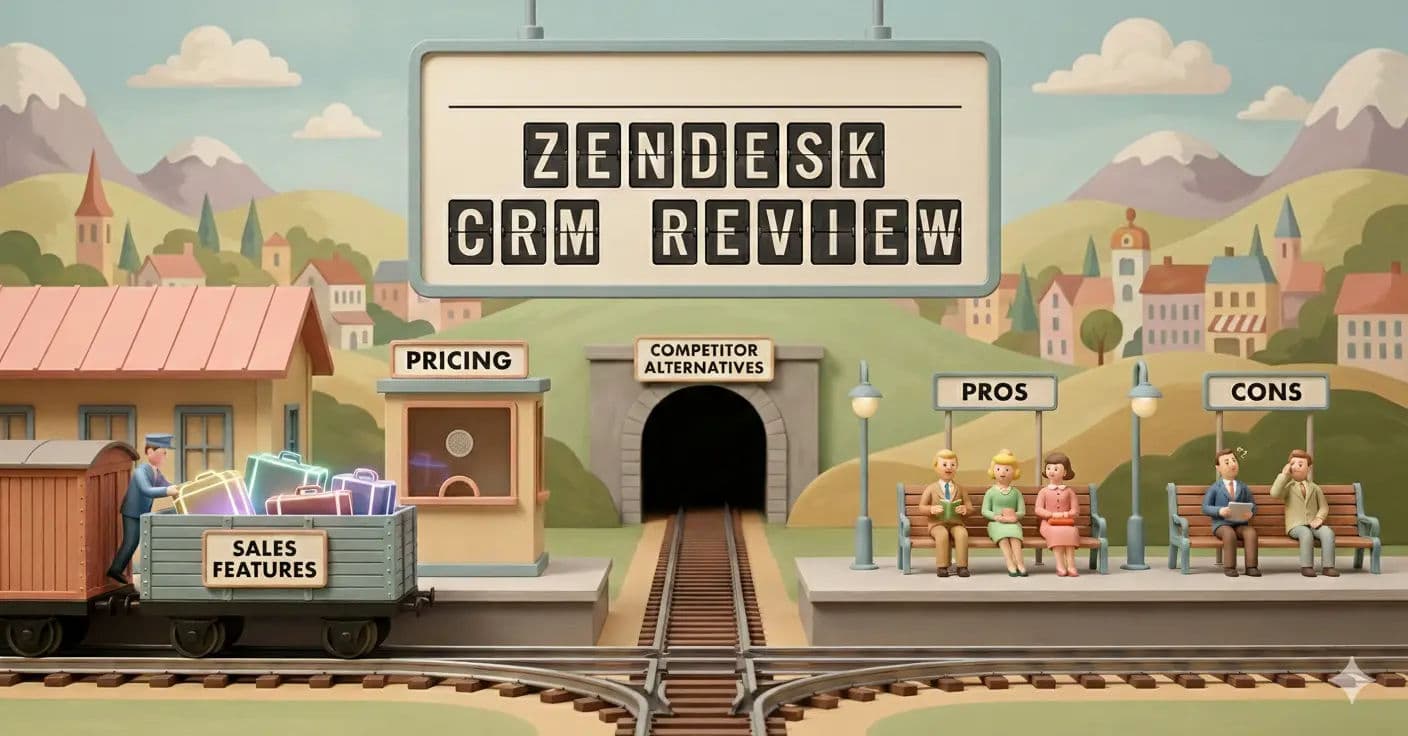
We will analyze its sales features, project its pricing, weigh its pros and cons, and benchmark it against key competitors. We'll explore whether its strength in ecosystem integration makes it the right choice for your sales and support-integrated teams.
What is Zendesk CRM (Zendesk Sell)?
Zendesk CRM, officially known as Zendesk Sell, is the sales force automation (SFA) arm of the broader Zendesk customer experience platform. While many know Zendesk for its dominant position in customer support software, Sell is its dedicated tool for managing leads, deals, and sales pipelines. It’s not a newcomer; it originated from the 2018 acquisition of Base CRM, a platform well-regarded for its intuitive interface and powerful mobile capabilities—a DNA still evident in Sell's user-friendly design.
However, viewing Zendesk Sell in isolation misses its fundamental value proposition. It is engineered to function as a native component of the Zendesk ecosystem. This design philosophy means that data flows bi-directionally between sales and support, creating a single, coherent timeline of every customer interaction. For businesses already using Zendesk for customer service, adopting Sell isn't just adding a CRM; it's activating the sales-focused module of a unified customer intelligence platform.
Key Benefits for Sales & Support-Integrated Teams
The primary advantage of Zendesk's integrated CRM lies in its ability to dissolve the traditional walls between pre- and post-sale activities. This creates tangible benefits:
A True 360-Degree Customer View: Sales reps can see a prospect's entire support history—every ticket, query, and resolution—directly within the contact record. This context is invaluable, preventing awkward outreach and enabling more personalized conversations.
Seamless Handoffs: When a deal is won in Zendesk Sell, the new customer's entire sales history is immediately available to the support and onboarding teams. This eliminates the need for customers to repeat themselves and ensures a smooth transition.
Proactive Upsell Opportunities: Support interactions become a rich source of sales intelligence. An agent can identify a customer asking about features in a higher-tier plan and, with one click, flag this opportunity and route it directly to the assigned sales rep in Sell with full context.
Improved Sales Velocity and Forecasting: By understanding customer health post-sale, sales teams can better predict churn and identify expansion revenue. A sales manager at a SaaS company like Attio could analyze support ticket trends alongside renewal data to build a more accurate revenue forecast.
Enhanced Customer Lifetime Value (CLTV): By creating a cohesive customer journey, the integrated platform directly impacts retention. Proactive support based on sales data and informed sales conversations based on support history lead to higher customer satisfaction, reduced churn, and ultimately, a greater CLTV.
🚀 Compare Zendesk CRM with leading alternatives and find the right fit without demos or sales calls. Try AuthenCIO
Zendesk CRM Sales Features Deep Dive
While its integration is its key selling point, Zendesk Sell must also stand on its own as a capable sales tool. Here’s a breakdown of its core features.
1. Lead Management & Generation
Zendesk provides solid tools for capturing, qualifying, and distributing leads. It offers customizable lead capture forms, email integration, and automated routing. Its lead scoring capabilities allow teams to prioritize high-intent prospects based on demographic data and engagement.
While Zendesk's native lead generation tools are less comprehensive than a marketing automation powerhouse like HubSpot, its strength lies in integration. By connecting with leading marketing platforms, sales teams receive higher-quality, context-rich leads, ensuring they have the full picture of a prospect's marketing engagement before the first call.
2. Deal & Pipeline Management
This is a core strength of Zendesk Sell. It features a highly visual, drag-and-drop pipeline interface that makes it easy for reps to manage their deals. Each deal card contains a wealth of information, including contact details, deal value, and an activity feed. Teams can create multiple, customized pipelines for different sales processes.
The system excels at activity tracking, prompting reps to log calls, emails, and meetings. This functionality is on par with dedicated pipeline-focused CRMs like Pipedrive, which is renowned for its user-friendly, activity-based selling approach.
3. Sales Forecasting & Reporting
Zendesk provides robust reporting dashboards that give sales managers clear visibility into team performance and revenue projections. Key reports include sales forecasts, pipeline analysis, and goal attainment. Crucially for integrated teams, managers can build reports that correlate support metrics (like ticket volume or CSAT scores) with sales outcomes (like renewal rates or upsell conversions), providing a holistic view of customer health and revenue.
For most SMB and mid-market teams, these features are more than sufficient. However, for large enterprises needing deeply granular custom reporting, a platform like Salesforce Sales Cloud offers a higher ceiling of customizability, albeit with a significantly steeper learning curve and higher total cost of ownership (TCO).
4. Sales Automation & Productivity Tools
To boost efficiency, Zendesk Sell incorporates several automation features. It includes automated task creation, email sequences (via its Reach add-on), and a click-to-call dialer. The real power, however, emerges from cross-functional automation. For example, a workflow can be created to:
Automatically trigger an onboarding sequence for the support team the moment a sales rep marks a deal as 'Won'.
Create a high-priority support ticket if a sales rep marks a deal as 'At Risk' due to technical issues, looping in experts proactively.
Alert a sales rep when a key account logs a critical support issue, preventing a renewal conversation from happening at the wrong time.
While effective, the automation is not as aggressive as that found in a high-velocity sales platform like Close. Similarly, platforms like Zoho CRM and Freshworks CRM often include a wider array of automation rules within their standard plans.
5. AI & Predictive Sales Capabilities
Looking toward 2026, Zendesk is increasingly infusing AI into its platform. For sales, this translates into predictive lead scoring, which analyzes historical data to identify prospects most likely to convert. AI can also surface at-risk deals based on communication patterns and lack of engagement, allowing managers to intervene proactively. While still evolving, these AI-driven insights are becoming central to maintaining a competitive edge.
6. Mobile CRM Capabilities
Originating from the mobile-first Base CRM, Zendesk Sell has a powerful, full-featured mobile app. Reps can manage their pipeline, log activities, and access contact information on the go. Features like geolocation and offline access make it a potent tool for field sales teams, competing effectively with offerings from Salesforce and HubSpot.
Zendesk CRM Pricing Plans & Tiers
Predicting exact pricing is difficult, but we can project based on current structures and market trends. As AI automates more tasks, expect a continued shift towards flexible, usage-based models alongside traditional per-seat pricing. It's also important to note that many CRMs, including Zendesk, offer discounts for annual commitments or bundling products.
Plan | Price* | Best for | Key features |
|---|---|---|---|
Support Team | US$19 | Small teams that need to get started quickly with streamlined email and basic omnichannel ticketing. | - Email and ticketing support |
Suite Team | US$55 | Growing support teams that want AI, messaging, and voice in a unified omnichannel suite. | - All Support Team capabilities |
Suite Professional | US$115 | Mature support organizations needing advanced analytics, workflows, and multi‑brand help centres. | - All Suite Team capabilities |
Suite Enterprise | US$169 | Large, complex service operations that require granular roles, sandboxing, and advanced change management. | - All Suite Professional capabilities |
*(per agent/month, billed annually)
Understanding Value: What's Included & Hidden Costs
The sticker price is only part of the story. The true value of Zendesk Sell is unlocked when bundled with Zendesk Support Suite. Businesses must factor in the cost of both products to calculate the TCO. Potential hidden costs can include add-ons like Zendesk Reach for prospecting or charges for premium API access. It's crucial to audit your feature needs against each tier to avoid overpaying.
👉 Not sure if Zendesk’s pricing and add-ons work for your budget? Use AuthenCIO to find CRMs that fit your team size and cost envelope.
Zendesk CRM Ecosystem & Integrations
A CRM's power is magnified by its connectivity. Zendesk excels in this area, particularly within its own product family.
1. Seamless Integration with Zendesk Support & Service
This is Zendesk's undeniable trump card. The native integration between Sell and Support is deep and seamless. A sales rep in Sell sees a real-time feed of a contact's support tickets. A support agent sees the customer's deal history from Sell. This shared context is incredibly powerful. A support team at a company like Monday.com could use this integration to prioritize tickets from high-value customers, directly impacting retention.
2. Third-Party Integrations
Zendesk maintains a robust marketplace with hundreds of third-party apps. Most of these are plug-and-play, requiring only a few clicks to set up, though complex custom workflows may require developer resources. This allows you to connect Sell with essential tools:
Marketing Automation: Connect with Mailchimp, Marketo, or even HubSpot, which is a common integration, with 41% of Zendesk users also using HubSpot CRM.
ERP & Accounting: Integrate with systems like NetSuite and QuickBooks.
Communication: Connect with tools like Slack and Zoom.
Project Management: Link to platforms like Monday.com or Jira.
Zendesk CRM: Pros & Cons
No CRM is perfect. A balanced evaluation requires an honest look at both its strengths and weaknesses.
Advantages of Using Zendesk CRM
Unmatched Native Support Integration: The primary benefit for companies prioritizing a unified customer experience.
Excellent User Interface (UI): Zendesk Sell is widely praised for its clean, intuitive interface, which boosts user adoption.
Strong Pipeline Management: The visual deal pipeline is a standout feature for reps and managers.
Robust Mobile App: The full-featured mobile CRM is ideal for teams in the field.
Potential Drawbacks & Limitations
Less Comprehensive as a Standalone CRM: When removed from its ecosystem, its feature set can be less extensive than sales-focused competitors like Salesforce or all-in-one platforms like HubSpot.
Pricing Can Escalate: While the entry-level plan is affordable, the cost rises significantly in higher tiers where key automation features are gated. This tiered model is common across the CRM industry but requires careful planning.
Niche for Specific Use Cases: Its greatest strength is also its defining characteristic. For a pure sales team with no support integration, a specialized tool like Close might be more efficient.
Let AuthenCIO compare ecosystems and integrations so you pick the right platform, not just a tool.
Zendesk CRM Competitor Alternatives
The CRM landscape is crowded. Here’s how Zendesk's sales platform stacks up against leading alternatives.
Aspect | Zendesk CRM | HubSpot CRM | Salesforce | Pipedrive |
|---|---|---|---|---|
Primary Strength | Native Sales & Support Integration | All-in-One Inbound Marketing & Sales | Enterprise-Grade Customizability | Simplicity & Pipeline Management |
Ideal User | Support-integrated SMBs & Mid-Market | Marketing-led businesses of all sizes | Large Enterprises & Complex Orgs | Sales-focused SMBs |
User Experience | Intuitive & Modern | User-Friendly & Clean | Complex & Powerful | Extremely Simple & Visual |
Pricing Model | Tiered, Per User | Freemium, Hub-based bundles | Tiered, Per User, High TCO | Tiered, Per User, Affordable |
1. Zendesk CRM vs. HubSpot CRM
HubSpot offers a powerful free CRM as a gateway to its ecosystem. Its strength is inbound marketing automation. When to choose HubSpot: If your primary goal is lead generation through content, SEO, and email marketing, HubSpot is the market leader. When Zendesk wins: If you have an established support team and prioritize a best-in-class, unified sales-to-service experience.

2. Zendesk CRM vs. Salesforce Sales Cloud
Salesforce is the market leader, holding nearly 24% of the global CRM market share. It is endlessly customizable for large enterprises with dedicated admin resources. When to choose Salesforce: When you are a large, complex enterprise needing unparalleled customization and have the budget and personnel to manage it. When Zendesk wins: For mid-market companies that need a powerful, user-friendly solution without Salesforce's complexity and cost.
3. Zendesk CRM vs. Pipedrive
Pipedrive is a CRM built for salespeople. Its focus is singular: providing a simple, visual, activity-driven tool for managing the sales pipeline. When to choose Pipedrive: If you have a pure sales team that needs an easy-to-use, affordable tool focused exclusively on pipeline management. When Zendesk wins: When you need a platform that extends beyond the pipeline to encompass the entire customer lifecycle.

4. Zendesk CRM vs. Zoho CRM
Zoho competes on value, offering a broad suite of business applications at an aggressive price. When to choose Zoho: If you are on a tight budget and need a wide array of tools, from CRM to finance, under one umbrella. When Zendesk wins: For those prioritizing a premium, seamless UI and the tightest possible integration between sales and support.

5. Zendesk CRM vs. Freshworks CRM
Freshworks is a direct competitor, having also started in customer support before expanding. Both offer a unified platform. When to choose Freshworks: The choice often comes down to specific feature preferences, UI, and pricing deals at the time of purchase. When Zendesk wins: Teams already invested in or preferring Zendesk's industry-leading support ecosystem will find the integration more seamless.

Other Notable Alternatives
Close: Choose Close for high-velocity inside sales teams that live on the phone and need elite communication tools like a power dialer.
Monday.com: A great choice for teams that want to manage sales pipelines and complex post-sale projects within the same highly customizable work OS.
Attio: Ideal for modern teams that prioritize relationship intelligence and want a CRM that automatically builds context from data streams like email and calendars.


🚀 Comparing Zendesk vs HubSpot, Salesforce, Pipedrive, or Zoho? Talk to an expert on AuthenCIO and get vendor-neutral guidance in plain language.
Is Zendesk CRM the Right Choice for Your Team in 2026?
Making the right CRM decision requires looking at your team's structure and goals. Zendesk's integrated CRM is an exceptional choice for a specific and growing business profile.
Ideal Use Cases & Business Sizes
Zendesk CRM shines brightest in small to mid-market B2B companies (50-500 employees) that view customer experience as a competitive advantage. It's often considered one of the best CRM for sales teams in:
SaaS Companies: Where the journey from sales to onboarding to support is continuous.
Service-Based Businesses: Where post-sale support is critical for retention and referrals.
Companies already in the Zendesk ecosystem: Adopting Sell is the most logical step toward a unified platform.
Key Considerations Before Adopting
Before committing, ask these critical questions:
Is sales and support alignment a top strategic priority? If yes, Zendesk should be on your shortlist. If they operate independently, its core value is diminished.
What is our total budget for the platform? Evaluate the combined cost of Zendesk Sell and Support Suite licenses to understand the true investment.
Does its standalone sales feature set meet our needs? Honestly assess if you require the specialized tools of competitors. Can Zendesk's features, plus integrations, satisfy your sales process?
What is our current CRM adoption rate? If your team struggles to use complex software, Zendesk's user-friendly UI can be a major advantage in ensuring the tool actually gets used, maximizing ROI.
Try AuthenCIO
Move to faster, smarter software evaluation with AI
Conclusion: The Future of Sales with Zendesk CRM
As we move through 2026, the lines between sales, marketing, and service continue to blur. Customers expect a single, coherent conversation with a brand. The trend toward a unified customer platform is now a necessity. In this landscape, Zendesk CRM's core philosophy—building a sales tool natively integrated with a world-class support platform—is not just relevant; it's prescient.
While it may not boast the most extensive feature list in every category compared to niche competitors, its strength lies in the power of its ecosystem. For businesses built around the customer, Zendesk Sell offers a compelling proposition: a user-friendly sales CRM that provides the context needed to build better, more profitable, and longer-lasting customer relationships.
The decision rests on your organization's DNA. If you are a sales-first organization where support is a separate function, specialized tools may serve you better. But if your growth strategy is built on a foundation of exceptional, integrated customer experience, Zendesk CRM is one of the most powerful and logical choices on the market.
👉 Try Authencio.com for free - a vendor-neutral platform that helps businesses compare and choose the right CRM without the guesswork or sales pressure.