
Introduction
In today's complex regulatory landscape, the Employee Master Record (EMR) has evolved from a simple digital filing cabinet into the central nervous system of your HR operations. For HR leaders, HRIS managers, and business owners, it's the definitive single source of truth (SSoT) for every piece of data related to your workforce. When this employee data system is fragmented or mismanaged, the consequences are severe. Research shows HR teams spend a staggering 23% of their time correcting data inconsistencies instead of focusing on strategic initiatives.
This guide provides a comprehensive, three-phase framework for designing, implementing, and maintaining a compliant, efficient, and secure Employee Master Record system. Moving beyond mere data storage, a well-architected EMR becomes a strategic asset that mitigates risk, drives operational efficiency, and builds a foundation of trust with your employees.
Streamline your software evaluation process
Understanding the 'Employee Master Record' (EMR) and Its Importance
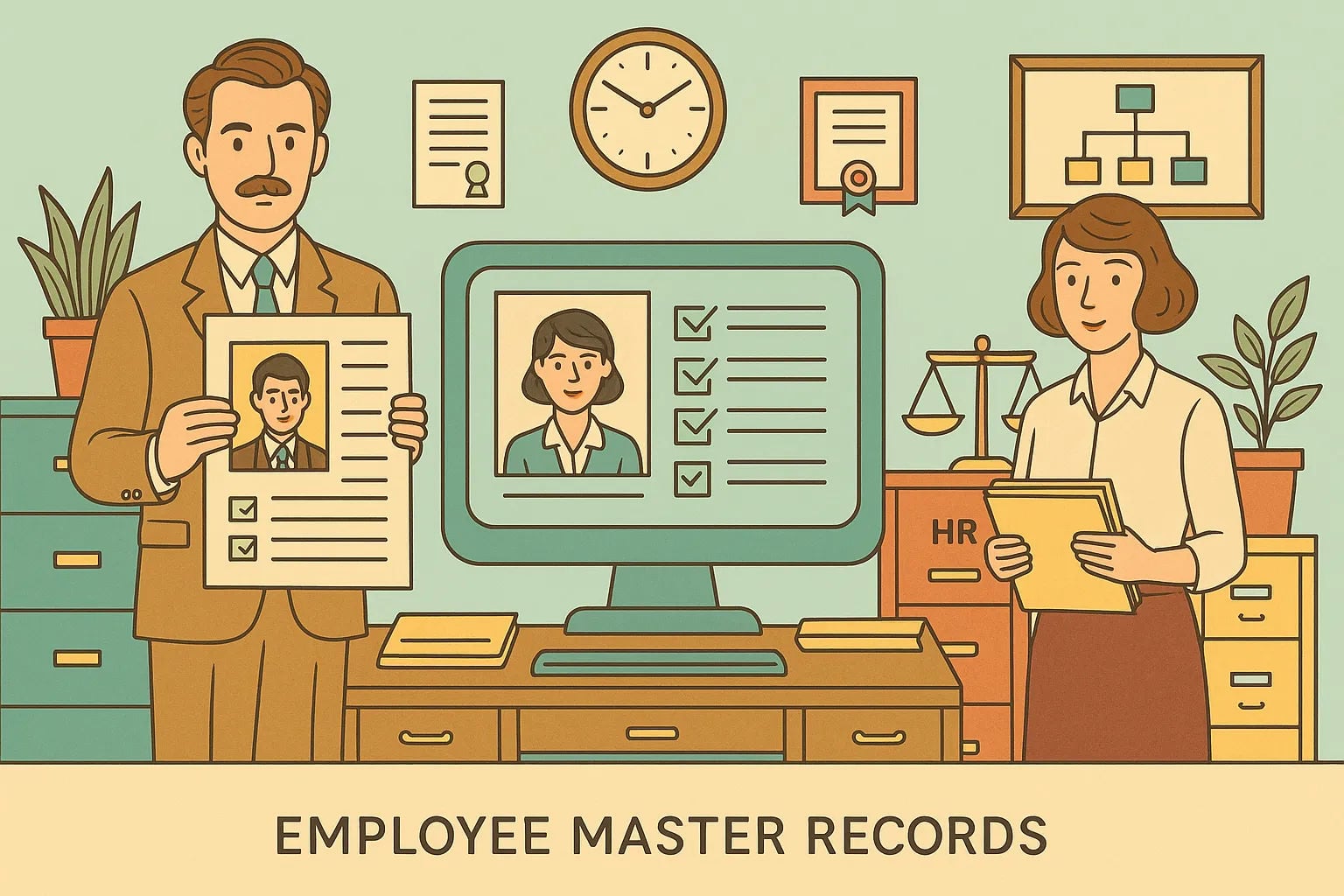
Before you can build your system, you must understand its components and strategic value. An EMR is more than a personnel file; it's a centralized, dynamic database that houses all critical information about an employee throughout their lifecycle with your company, from application to offboarding.
What Constitutes an Employee Master Record?
A compliant EMR is logically structured and segmented. While the exact fields will vary, a comprehensive system typically includes:
Personally Identifiable Information (PII): Full name, address, contact information, date of birth, national identifier (e.g., Social Security Number), and equal opportunity data.
Employment & Role Details: Job title, department, employment status (full-time, part-time, contractor), start date, termination date, and performance reviews.
Compensation & Payroll Information: Salary or hourly rate, pay frequency, bank details, tax forms (W-4, I-9), and bonus/commission structures. Systems like Gusto and ADP are built to manage this core data with precision.
Benefits Administration: Health insurance selections, retirement plan contributions, and other elected benefits.
Time & Attendance Data: Hours worked, overtime, leave balances, and attendance records, often integrated from specialized systems like Atto or Hubstaff.
Compliance & Legal Documentation: Signed offer letters, policy acknowledgments, non-disclosure agreements, and any disciplinary action records.
Emergency Contacts & Health Data: Designated emergency contacts and relevant health information required for workplace safety or accommodations, handled with extreme care under regulations like HIPAA.
Custom & Industry-Specific Fields: A flexible EMR allows for custom fields to track certifications, licenses, security clearances, or other data unique to your industry or organization.



💡 Not sure which HRIS can handle all these EMR fields without creating data chaos? Let AuthenCIO help you compare leading HR platforms side-by-side based on your specific requirements.
Why is EMR Compliance Critical for HR Software Buyers & Users?
In an era where data privacy regulations are rapidly expanding—with 42% of U.S. states having enacted comprehensive laws—EMR compliance is non-negotiable. The financial and reputational risks are immense. As per IBM report, the average cost of a data breach has reached $4.45 million, and GDPR fines can be catastrophic.
A robust employee master record system protects your organization and creates value by:
Mitigating Legal Risk: Ensuring adherence to a complex web of labor laws and data privacy regulations.
Enhancing Data Integrity: Preventing costly errors in payroll (which platforms like Paylocity help manage), benefits, and reporting that arise from inconsistent or inaccurate data.
Improving Operational Efficiency: Automating data collection and retrieval, freeing HR teams from manual reconciliation to focus on strategic initiatives.
Enabling Strategic Workforce Planning: Providing clean, reliable data for analytics, talent management, and informed decision-making.
Building Employee Trust: Demonstrating a commitment to protecting employee data fosters a culture of trust and improves engagement.

Key Regulatory Frameworks Governing Employee Data Compliance
Designing a compliant EMR requires a foundational understanding of the legal frameworks that govern employee data. These regulations dictate what you can collect, how you must store it, and for how long.
1. Global Data Privacy Regulations (e.g., GDPR, CCPA, LGPD)
Regulations like the EU's General Data Protection Regulation (GDPR) and the California Consumer Privacy Act (CCPA) have set a global standard for data privacy. Key principles that directly impact EMR design include:
Data Minimization: Collect only the data that is strictly necessary for the stated purpose.
Purpose Limitation: Use employee data only for the specific, explicit, and legitimate purposes for which it was collected.
Data Subject Rights: Employees have the right to access, correct, and request the deletion of their personal data.
2. Industry-Specific Compliance Standards (e.g., HIPAA, SOX)
Certain industries have additional layers of compliance. Healthcare organizations must adhere to the Health Insurance Portability and Accountability Act (HIPAA) to protect sensitive health information, with enforcement actions in 2024 resulting in $36.9 million in penalties. Publicly traded companies must comply with the Sarbanes-Oxley Act (SOX), which requires stringent internal controls and audit trails for financial data, including payroll records within the EMR.
3. Local Labor Laws and Record-Keeping Requirements
Beyond broad privacy laws, you must adhere to a patchwork of local and national labor laws. For example, the U.S. EEOC mandates that employers retain personnel records for at least one year post-termination, but states like California often have longer, more specific requirements. Furthermore, for global companies, data residency laws may dictate that an employee's data must be stored within their home country, adding another layer of complexity that modern HR platforms like Papaya Global are designed to address.

🚀 Turn EMR compliance from a risk into an advantage — compare HR and payroll vendors by compliance, security, and audit-readiness in one place, without vendor bias.
Phase 1: Strategic Planning for Your Compliant EMR System
A successful EMR implementation begins with a strategic blueprint. Rushing this phase is a common mistake that leads to system failures and wasted investment.
1. Defining Data Categories and Fields
Before choosing a system, you must know what you need to manage. Conduct a data mapping exercise to identify every piece of employee data you collect. For each data point, ask:
What is the data? (e.g., Home Address)
Why do we collect it? (e.g., For payroll tax purposes and mailing official documents.)
Is it legally required or a business need? (e.g., Legally required.)
Who needs access to it? (e.g., HR and Payroll administrators only.)
How long must we retain it? (e.g., 7 years post-termination, per company policy and legal advice.)
This exercise forms the foundation of your data governance and minimization strategy.
2. Establishing Data Ownership and Governance Policies
Create a clear data governance framework. Who is responsible for the accuracy and integrity of employee data? Define roles and responsibilities using a model like a RACI matrix (Responsible, Accountable, Consulted, Informed) across HR, IT, Legal, and Finance. This policy should outline procedures for data entry, updates, and validation, ensuring a clear chain of command for your digital employee records management.
3. Developing Data Retention and Disposal Schedules
Your data retention policy is a cornerstone of compliance. It must specify how long each category of employee data should be kept, based on a combination of legal requirements and business needs. Equally important is the protocol for secure data disposal (e.g., cryptographic erasure or physical destruction) once the retention period expires to avoid unnecessary risk.
4. Building the Business Case for EMR Investment
To secure leadership buy-in, you must quantify the ROI of a modern EMR system. Frame the investment around three key areas:
Risk Mitigation: Calculate the potential cost of non-compliance, citing average data breach costs ($4.45M) and regulatory fines.
Operational Efficiency: Estimate the hours your HR team spends on manual data entry and reconciliation. A 23% time-spend on data correction for a team of three HR professionals can translate to thousands of dollars in lost productivity annually.
Strategic Enablement: Emphasize how clean, centralized data from a system like HiBob or Rippling enables better analytics, accurate headcount planning, and faster, more informed business decisions.


👉 Want a shortlist of HR platforms that match your budget, headcount, and compliance needs? Let AuthenCIO narrow the market so your team only evaluates real contenders.
Phase 2: Implementing a Robust and Compliant EMR Solution
With a strategic plan in place, you can now select and implement the technology to bring your compliant employee record management best practices to life.
1. Selecting the Right HRIS/HRMS for EMR Management
Modern HR software is the engine of a compliant EMR. Solutions like Zoho People, ADP, and Rippling offer comprehensive platforms designed to centralize and manage employee data effectively. When evaluating HR software for employee data compliance, use this checklist:
Essential HRIS Compliance Features: A Vendor Checklist
Role-Based Access Control (RBAC): Ask the vendor: Can we create custom roles with field-level permissions to enforce the principle of least privilege?
Immutable Audit Trails: Ask the vendor: Does the system log every change to a record, including who, what, and when, in a way that cannot be altered?
Data Encryption: Ask the vendor: Is data encrypted both at-rest (on your servers) and in-transit (over the network)? What encryption standards are used?
Configurable Workflows: Ask the vendor: Can we automate approval workflows for data changes, like a promotion or salary update?
Integration Capabilities: Ask the vendor: Do you have native integrations with our key systems, such as our payroll provider (QuickBooks, Gusto) or time-tracking tools (Hubstaff, Atto)?
Global Compliance Support: Ask the vendor: How does your platform handle multi-country data requirements, including data residency and localized compliance formats?


2. Managing Different Employee Types
Your chosen EMR system must be flexible enough to handle various worker classifications. The data fields and compliance requirements for a full-time employee differ significantly from those for a contractor or a global employee hired through an EOR. Modern platforms like Deel and Multiplier are specifically designed to manage these complexities, ensuring the correct contracts, tax forms, and compliance documentation are collected and stored for each worker type, regardless of their location.


3. Data Migration Best Practices: Ensuring Accuracy and Integrity
When moving data from legacy systems, prioritize a clean migration. This involves:
Data Cleansing: Before migration, use tools (even advanced spreadsheet functions) to identify and correct duplicates, inconsistent formatting (e.g., "CA" vs. "California"), and missing values.
Sandbox Testing: Conduct a trial migration in a secure sandbox environment to identify potential issues without affecting your live data.
Post-Migration Validation: After the final migration, run reports in both the old and new systems to ensure all data was transferred accurately and completely.
Phase 3: Operationalizing and Maintaining EMR Compliance
Launching your EMR system is not the final step. Ongoing diligence is required to maintain its integrity and compliance.
1. Onboarding and Offboarding Processes for EMR Updates
Integrate EMR management into your core HR workflows. For onboarding, use a standardized digital process to collect all necessary data and documentation. During offboarding, follow a strict checklist to ensure access is revoked, final pay is processed correctly, and data is archived according to your retention policy. For global teams, platforms like Papaya Global can automate these complex cross-border offboarding workflows.
2. Regular Data Audits and Validation
Compliance is not a one-time event. Schedule regular audits to verify the accuracy and completeness of your EMR data. The frequency can depend on your size; a large enterprise might conduct quarterly payroll data reconciliations, while a mid-sized company might perform a semi-annual audit of I-9 forms and benefit enrollments. HR platforms like HiBob offer powerful reporting tools that can help you quickly run an HR audit on employee records to identify anomalies or gaps.
3. Training Employees on Data Handling and Privacy Protocols
Your employees are your first line of defense. Conduct mandatory, role-based training for all staff on your company's data privacy policies, security protocols (like identifying phishing attempts), and their responsibilities in protecting employee data. This builds a culture of security awareness across the entire organization.
4. Responding to Data Subject Access Requests (DSARs)
Have a clear, documented process for handling DSARs. Under regulations like GDPR, you have a limited time to respond to employee requests for their data. A centralized EMR makes it vastly easier to locate, compile, and provide this information in a timely, compliant manner.
Ready to modernize your HR stack for cleaner audits and stronger controls?
Common Pitfalls to Avoid in EMR Compliance
Even with the best intentions, organizations can make critical mistakes. Be vigilant and avoid these common pitfalls:
Common Pitfall | Impact/Risk Description |
|---|---|
Weak access controls or security practices | Increases data breach risk, potential regulatory violations |
Lack of retention/deletion policy | Leads to unnecessary data storage, non-compliance with privacy laws |
Inconsistent data entry standards | Results in inaccurate records and unreliable reporting |
Ignoring cross-border legal requirements | Exposure to global fines, legal challenges |
Poor change management in HRIS migration | Disrupts HR operations, risks data loss or corruption |
Weak vendor security review | Hidden vulnerabilities, third-party breach risks |
The Future of Compliant Employee Master Records: AI and Automation
The field of HR compliance is rapidly evolving, with a clear trend toward continuous, automated monitoring. When evaluating future-proof systems, look for capabilities that leverage advanced technology to move from reactive to proactive compliance.
Leveraging AI for Data Anomaly Detection
Look for HR software with AI-powered tools that can monitor data in real-time, automatically flagging anomalies—such as an employee's salary falling outside their designated pay band—that could indicate an error or a potential compliance issue. This allows for proactive correction before problems escalate.
Automating Compliance Workflows and Reporting
Automation can significantly reduce the administrative burden of compliance. Forward-thinking systems will automatically generate alerts for expiring I-9 documents or required certifications, trigger data retention workflows, and compile the necessary reports for internal or external audits with minimal human intervention.
While powerful, it's crucial to address the ethical considerations of AI, ensuring algorithms are free from bias and that human oversight remains a key part of the process.
Try AuthenCIO
Move to faster, smarter software evaluation with AI
Conclusion: Building a Foundation of Trust and Compliance
Designing a compliant Employee Master Record is a strategic imperative for any modern organization. It is far more than an administrative task; it is a foundational element of risk management, operational excellence, and corporate governance. By following a structured approach—from strategic planning and thoughtful implementation to diligent maintenance—HR professionals can transform their employee data system from a source of anxiety into a powerful strategic asset.
A well-architected EMR not only protects the organization from costly penalties but also builds a culture of trust by demonstrating a commitment to protecting employees' most sensitive information. It provides the clean, reliable data needed to make smarter decisions about your most valuable asset: your people.
Ready to navigate the complex world of HR software and find the right solution for your compliant EMR?
👉 Try Authencio.com for free - a vendor-neutral platform that helps businesses compare and choose the right HR software without the guesswork or sales pressure.